
Every Death Has a Counterfactual
April 21, 2026
Mortality data, case-level digital twins, and a Preventability Score for overdose prevention.
By Jim Nasr, Acoer, CEO | acoer.com
Dr. Brandi McCleskey is a lead forensic pathologist. This morning she is writing up a case about an overdose in a Jefferson County, AL neighborhood that contains most everything her county would need to prevent the next overdose in that same neighborhood.
However, the contents of the case is a path to prevention: Scene details. What was present and what was not. Who was present and who was not. What the last hour probably looked like. And what a small number of modifiable changes in the preceding days, hours or even minutes might have done to saving that life.
Medical examiner and coroner (ME/C) case files are the richest case-level record of preventable death in American public health. We are not using them that way. Most of the signal is in narrative text, hidden gems foretelling the future that very few read and even less create actionable steps from.
The gap in US public health is case-level, practical, and empty
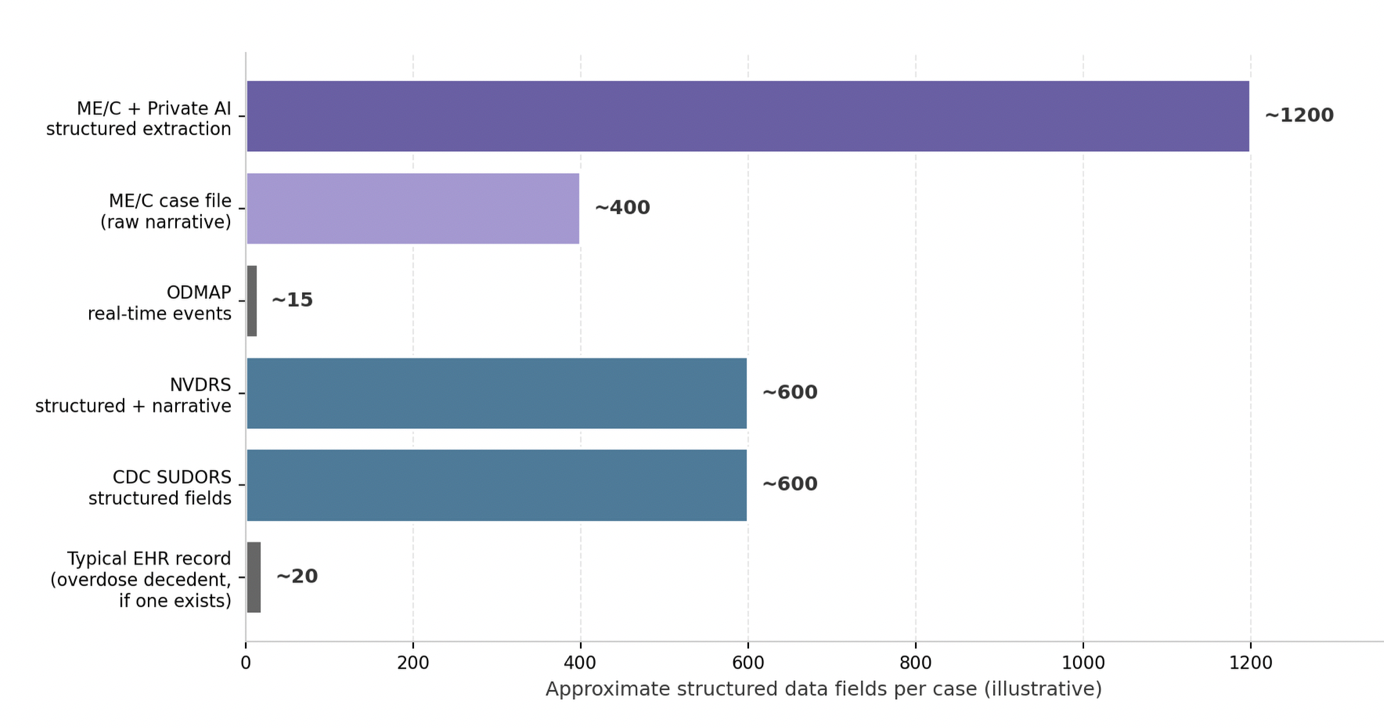
The US records more than 100,000 drug overdose deaths a year.¹ Each one generates a dense record of investigative, toxicological, and scene-level evidence held by an ME/C office. National surveillance systems pull structured fields out of a subset of these records. The State Unintentional Drug Overdose Reporting System (SUDORS) abstracts around 600 structured variables per case, drawn from death certificates, autopsy reports, toxicology, and scene reports.² The National Violent Death Reporting System (NVDRS) does the equivalent for suicides, homicides, and other violent deaths at a similar field count.³ The Overdose Detection Mapping Application Program (ODMAP) does real-time event surveillance but captures only a handful of fields per event.⁴
The narrative detail, which is where most of the prevention signal lives, stays inside unstructured text and not easily surfaced by traditional case management systems.
On the other hand, as example, national microsimulations and agent-based models have been running in the opposite direction. The Stanford-Lancet SOURCE microsimulation projects nearly 1.2 million additional US opioid deaths by 2029 without structural policy change.⁵ The HEALing Communities Study tested a community intervention bundle against overdose mortality at population scale and reported a statistically significant but modest county-level effect.⁶ Agent-based models like SiCLOPS simulate synthetic populations of people who use drugs.⁷
None of these ever touch the individual case file. You cannot ask a microsimulation who specifically died, who did not have to.
The gap is case-level, practical, and empty. That is where the opportunity is for innovation.
Overdose Fatality Review is the gold standard, and it cannot scale
Overdose Fatality Review (OFR) is the existing method for pulling prevention insight out of individual cases. It was adapted from child fatality review in the late 2000s. A multidisciplinary team reads a small number of completed ME/C cases, usually with the pathologist, an investigator, EMS, law enforcement, harm reduction, treatment providers, and public health at the table.⁸ The team works through each case as a single narrative: what happened, what was in place, what was missing, what could have changed the outcome. The output is a set of recommendations to the county, and, over time, a pattern across cases.
OFR is good work. It has directly informed naloxone leave-behind programs, post-overdose outreach protocols, and medication-assisted treatment continuity after jail release in multiple jurisdictions.⁹ The qualitative reasoning a pathologist and a social worker can do together over a case file is precisely the kind of reasoning that case-level prevention requires.
However, there are at least three observable limits to OFRs:
First, throughput. A typical county OFR committee reviews somewhere between ten and a hundred cases per year. Most counties with meaningful overdose burden have more drug-related deaths in a single year than a committee can read in five. Volume review is not the method. Depth review is. That is a feature, not a flaw, but it means most cases never get the committee's attention.
Second, selection. The cases that get reviewed are usually chosen for readability, completeness, recency, or interest to a specific agency at the table. Selection bias is built in. Whatever the committee learns is conditioned on which cases made it into the room.
Third, aggregation. OFR recommendations are narrative. They are hard to roll up across counties or across years in a way that supports budget allocation. The same recommendation can mean different things in two different committees' minutes.
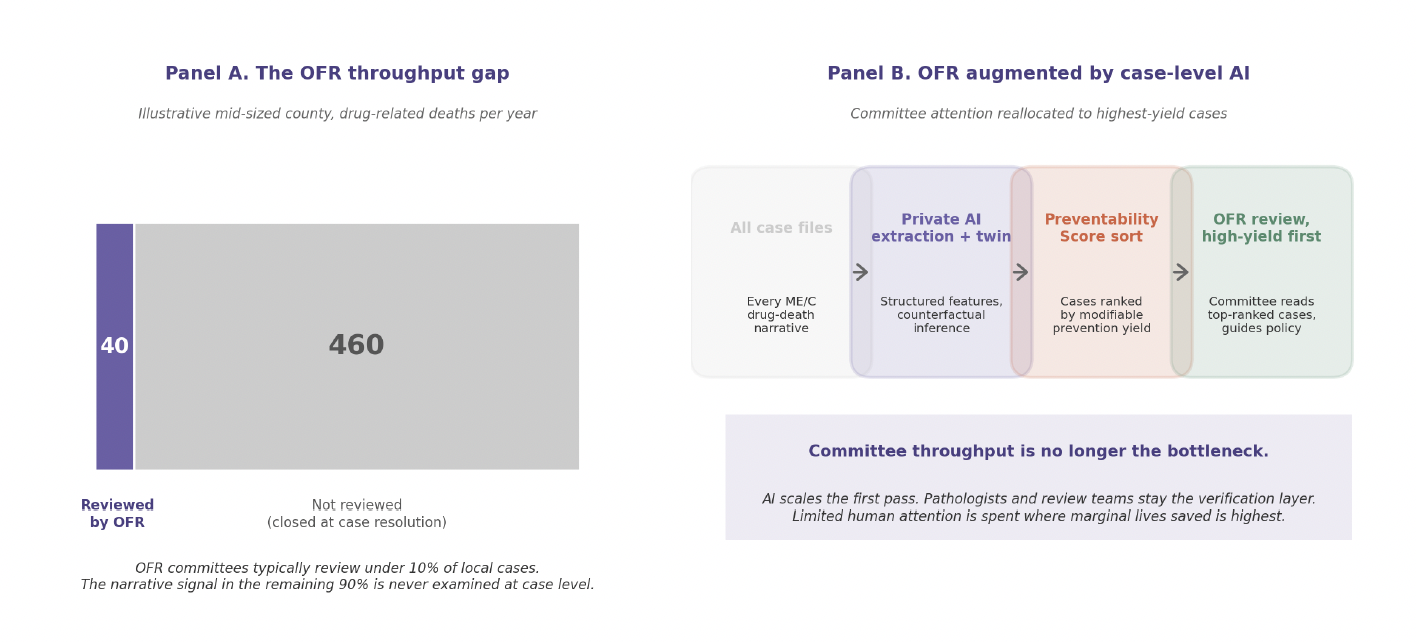
None of this is a criticism of OFR—just a description of the bottleneck. The committee is the most valuable hour in the system. It should be protected, not replaced. That is the design constraint everything else in this essay has to respect.
Opportunity for using private (and ethical) AI to create Digital Twins
Private AI does not replace the committee. But, it can do the first pass.
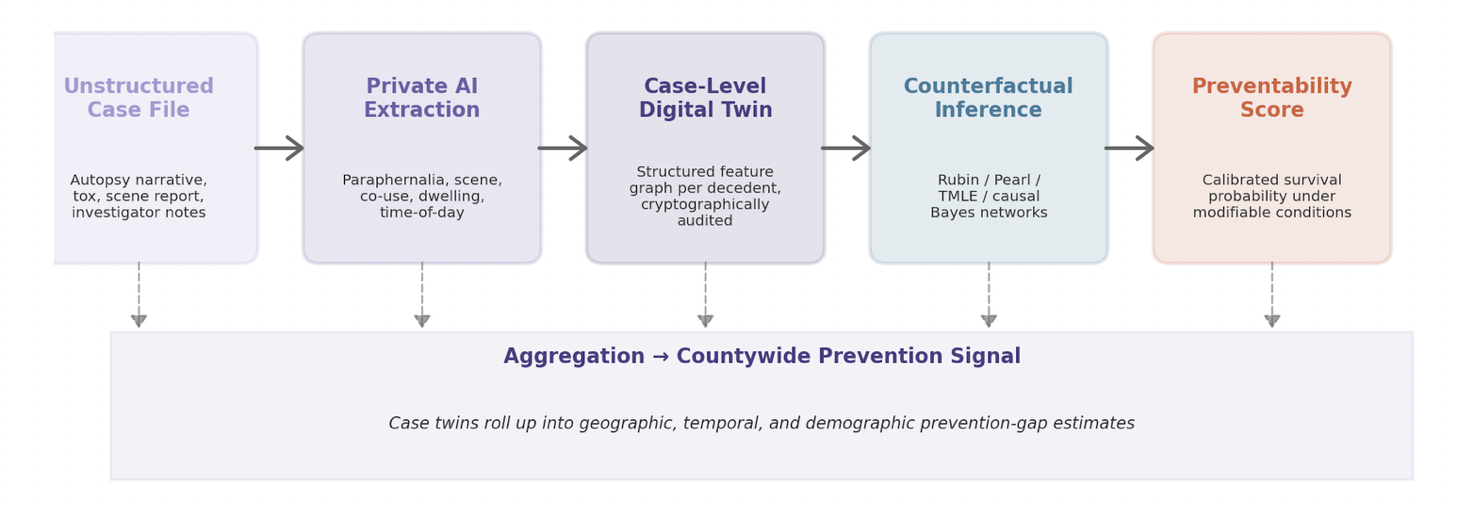
Deployed within an ME/C office's dedicated infrastructure, a domain-tuned large language model can read each autopsy file, toxicology panel, investigative narrative and investigator notes and create a structured schema for every case. These can include many details often hidden in the narratives: drug paraphernalia, site markings, co-use indicators, harm-reduction artifacts present (or absent), investigator-observed behaviors, witness status, encounter with Emergency Medical Services and so on.
This technical feasibility is not theoretical. Ward and colleagues showed in Tennessee that natural language processing of ME reports could accurately extract overdose features that were absent from the corresponding structured fields.¹⁰ The CDC NVDRS program has piloted large language model extraction against violent death narratives and reported accuracy competitive with human abstractors at a fraction of the time.¹¹
Acoer's Forensic Intelligence Platform has extended this approach under cryptographic auditability to 1,500-plus drug-related death narratives from the Jefferson County Coroner/Medical Examiner Office in Alabama (2020 through 2025), in collaboration with Dr. Brandi McCleskey's team.
What is new is not the use of natural language programming. It is the operating model. Private deployment. Forensic chain of custody. Every extracted field tied to a cryptographic record of the source span in the narrative, so a reviewer can click any structured value and see the exact sentence that produced it. No external model training. No cross-jurisdictional data pooling. The county's data stays the county's data.
In forensic medicine, chain of custody is not optional. Every AI inference needs the same treatment. A claim without provenance is not evidence of anything.
A data-richness problem, not a data-scarcity problem
Outsiders assume the problem with case-level prevention data is that there is not enough of it. The opposite is true. There is an enormous amount of it. It is in the wrong format.
The Digital Twin of a preventable death
With AI, extraction of information from files is the floor. The ceiling is the Digital Twin.
A Digital Twin in this context is a structured, continuously updated computational model of a specific case. Toxicology, scene, dwelling, co-occurring substances, harm-reduction artifacts, investigator observations, prior EMS or treatment encounters where linkable.¹² Each decedent becomes a node with real features from real records. Not a synthetic agent. Not a population average. A twin of this case.
Digital Twins have matured fastest in cardiology, oncology, and critical care. Corral-Acero and colleagues laid out the architecture for patient-specific cardiac twins.¹³ More recently, DT-GPT, a large-language-model-based digital twin for clinical trajectory prediction, demonstrated competitive forecasting against machine learning baselines in non-small-cell lung cancer and intensive care cohorts.¹⁴ The forensic application is a natural extension. The difference is that the twin is built after the terminal event, not before.
From there, the counterfactual becomes a computable object. For this specific case, what was the probability of survival if naloxone had been present? If a bystander had called 911 within a defined window? If fentanyl test strips had been used? If buprenorphine had been accessible in the prior ninety days? If housing had been stable? If supervised consumption had been available?
None of this requires methodological invention. Rubin potential outcomes gives the formal definition of the counterfactual.¹⁵ Pearl's do-calculus gives the graphical criteria for when a causal effect is identifiable from the data on hand.¹⁶ Targeted maximum likelihood estimation (TMLE) is a doubly-robust estimator well-suited to rich, high-dimensional observational data.¹⁷ Causal forests and generalized random forests estimate heterogeneous treatment effects at the individual case level.¹⁸,¹⁹ These methods have been in the peer-reviewed literature for decades in the case of Rubin and Pearl, and for years in the case of the rest.
The novelty here is not the mathematics. The novelty is running these methods on case-level ME/C data, under forensic pathologist oversight, inside a private auditable environment, at a volume no fatality review committee could ever reach.
The Preventability Score
Once we estimate case-level counterfactuals, we can also produce a number that did not exist before.
We call that a “Preventability Score”. For each case, a value in [0, 100] summarizing the probability the death could have been averted under a defined set of modifiable interventions. Not a judgment of anyone's actions. A measurement of system gaps, on the record, at case resolution.
To be clear, this Preventability Score is not a single point estimate dressed up with false precision. It is a calibrated range with documented assumptions, documented confounding, and documented sensitivity to unmeasured variables.
This is where the work either earns scientific standing or loses it. The approach is a fairly conventional one: E-values for sensitivity analysis.²⁰ Negative controls. Pre-registered assumptions reviewed against each cohort. Subgroup audit for algorithmic bias, because Obermeyer and colleagues showed exactly how a widely deployed US healthcare algorithm under-allocated care to Black patients, and an overdose score without stratified calibration would reproduce that failure in a population that most needs its benefit.²¹
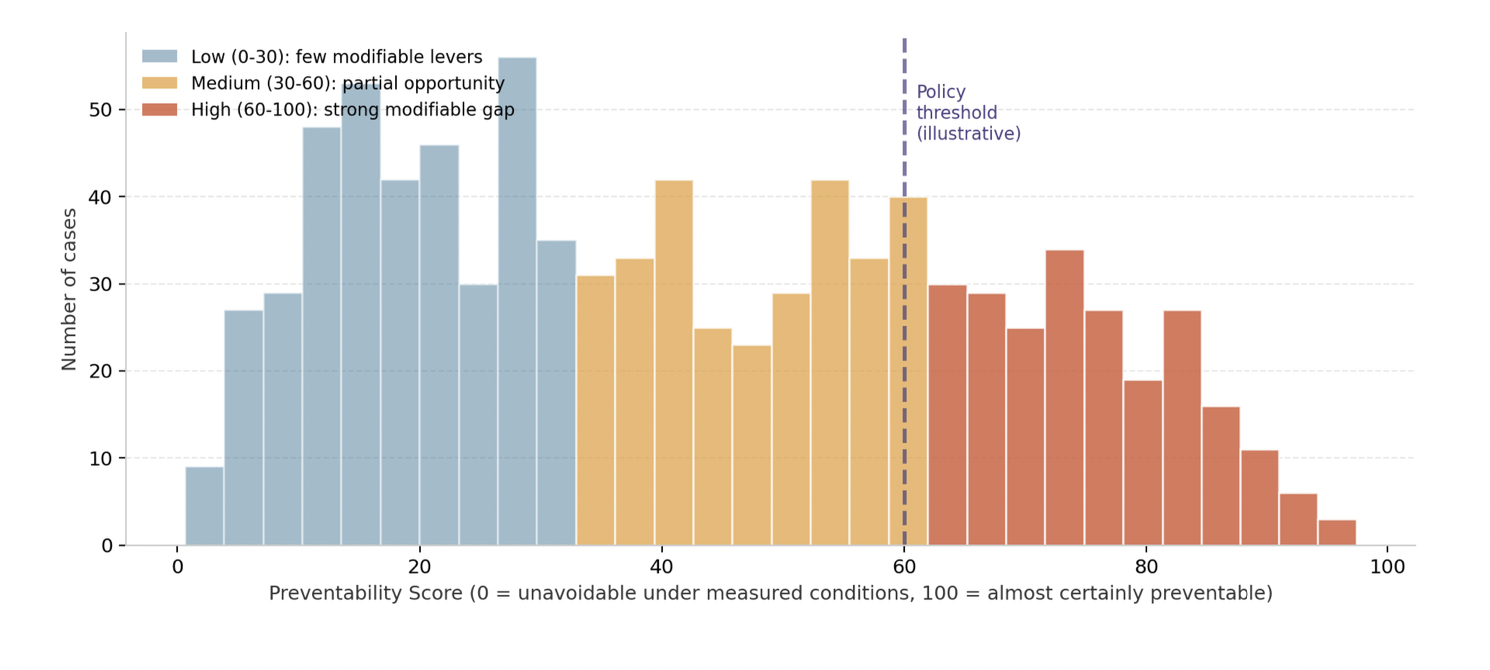
The job of the Preventability Score is translation: It translates a case file into a policy input. It translates a narrative into a number a county health officer can use. It translates the pathologist's intuition about a case (this one did not have to happen this way) into a defensible, auditable estimate that can be aggregated with the rest of the cohort.
Aggregate enough of these and the output is no longer a list of tragic deaths. It is a map of where the next dollar of prevention budget produces the most expected lives saved.
How this actually augments OFR
As mentioned earlier, the point of this AI innovation is not to replace OFR. The point is to make OFR do what it has always been trying to do: pull prevention insight out of every preventable death, not just the few that fit into the committee's schedule.
The suggested augmented workflow us shown in Panel B of Figure 1. AI reads every drug-death case file in the county, emits a structured record, builds the twin, runs the counterfactual menu, and produces a Preventability Score per case. The committee receives the docket already ranked. High-yield cases go to the top. Cases with a thin record or a very low score can be deferred. The committee still reads the cases. The committee still reasons through them. The committee still writes the recommendations. Committee hours go further because the first pass is done.
Over time, two other things happen.
First, OFR recommendations become labeled data. When a committee disagrees with the score's interpretation of a case, that disagreement is information. It is used to recalibrate. Committees stay in the loop permanently, not as a launch gimmick, and their expertise gets amplified across the full case volume.
Second, aggregation becomes possible. Because every case in the county has a Preventability Score, and every score has a documented decomposition across a pre-specified intervention menu, a county can say concretely where the preventable deaths clustered this year. Not as anecdote. As a cohort-level statistic with uncertainty bounds.
That is the structural difference. OFR today reads a few cases deeply. OFR augmented reads every case at the structured-feature level, and reads the highest-yield ones deeply. No step gets skipped. The committee's time gets spent where its time is most valuable.
Data streams that make the twin real
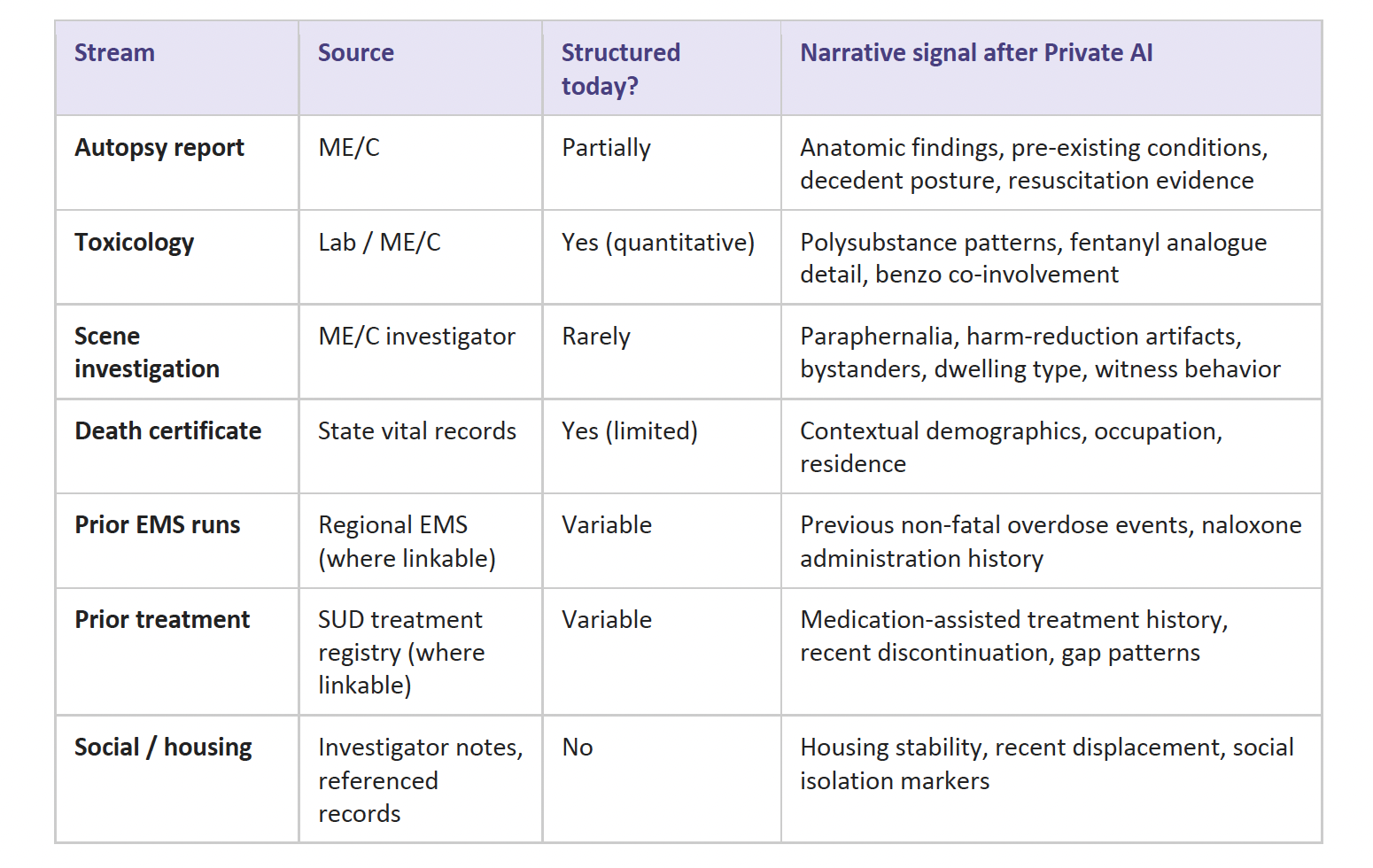
The Digital Twin is only as good as the streams feeding it. For overdose decedents, the realistic stream map is the following.
What changes when a county has this
Harm-reduction distribution stops being allocated by intuition and starts being allocated by case-level signal. Naloxone gets placed where the scores say it should be. Fentanyl test strips get distributed in the scenes where their absence drove the highest-score cases. Post-overdose outreach gets directed at the dwelling patterns, neighborhoods, and co-use profiles where the Preventability Score tail sits.
Medical examiners and coroners reposition. They stop being the endpoint of a fatal case or worse non-stakeholders since “the dead don’t vote”. They become an active upstream contributor to the prevention of the next one.
That has been the quiet promise of forensic medicine for a century: speak for the dead to save the living. The case-level Digital Twin and the Preventability Score are the infrastructure that lets that promise materialize at policy scale.
The principles that cannot bend
No external model training. The data never leaves the jurisdiction’s control. The data does not go to a public AI site, where data privacy and model training are controlled by a central tech company. No cross-jurisdictional pooling. County data sovereignty is absolute.
Cryptographic auditability of every AI inference. In forensic medicine, chain of custody is everything. An inference without provenance is not admissible as evidence of anything.
Forensic pathologist oversight as the verification layer—this is the “human in the loop” to ensure against hallucination and bias, to help AI improve through expert human feedback. The ME/C office owns the science. The AI is infrastructure.
Algorithmic bias is an imminent and ongoing risk. Human-based calibration and cryptographically verifiable auditability are the minimum standard.
Open method, closed data
This is an important leap in improving prevention through mortality insight. The methods must be published and repeatable. This includes, the ontology, the intervention menu, the calibration protocol, the subgroup audit framework, and the score specification.
The findings also need to be published and made available to counties and jurisdictions. That create real value beyond any one project or any one county. However, all data must remain private and remain in full sovereignty of the owners of the data—provably.
Open method. Closed data. Forensic standard.
A closing note
We have spent the last few years debating where AI fits into healthcare. It’s clear now that it does in much of healthcare and must be used to increase productivity and job satisfaction of its most scarce resource: expert, overworked practitioners.
In public health, so much intelligence is buried in text nobody has time to read. Mortality data is an easy example. Every death has a counterfactual. For too long we have closed the file before asking what that is.
We can now do that with AI powered Digital Twins and a standardized Preventability Score.
References
1. Centers for Disease Control and Prevention, National Center for Health Statistics. Drug Overdose Deaths in the United States. NCHS Data Briefs (2024 release).
2. CDC. State Unintentional Drug Overdose Reporting System (SUDORS): Variables and Coding Manual. National Center for Injury Prevention and Control.
3. CDC. National Violent Death Reporting System (NVDRS): Coding Manual.
4. Washington/Baltimore HIDTA. Overdose Detection Mapping Application Program (ODMAP): Program Overview.
5. Humphreys K, Shover CL, et al. Responding to the opioid crisis in North America and beyond: recommendations of the Stanford-Lancet Commission. The Lancet 399 (2022): 555-604.
6. HEALing Communities Study Consortium. Community-based cluster-randomized trial to reduce opioid overdose deaths. New England Journal of Medicine (2024).
7. Marshall BDL et al. Agent-based modeling for the opioid epidemic: SiCLOPS and related frameworks. Addiction (various years).
8. Substance Abuse and Mental Health Services Administration. Overdose Fatality Review: A Practitioner's Guide to Implementation. SAMHSA Publication.
9. Johns Hopkins Bloomberg School of Public Health, Center for Gun Violence Prevention and Policy. Overdose Fatality Review: Lessons from the Field. (Program reports, various years.)
10. Ward PJ, Rock PJ, Slavova S, et al. Enhancing surveillance of drug overdose deaths using natural language processing of medical examiner reports. Public Health Reports (2023).
11. Centers for Disease Control and Prevention, Division of Violence Prevention. Large language model extraction against NVDRS narratives: pilot results. JMIR AI (2025).
12. Bruynseels K, Santoni de Sio F, van den Hoven J. Digital twins in health care: ethical implications of an emerging engineering paradigm. Frontiers in Genetics 9 (2018): 31.
13. Corral-Acero J et al. The Digital Twin to enable the vision of precision cardiology. European Heart Journal 41 (2020): 4556-4564.
14. Makarov N et al. Large language models forecast patient health trajectories enabling digital twins. npj Digital Medicine (2025).
15. Rubin DB. Estimating causal effects of treatments in randomized and nonrandomized studies. Journal of Educational Psychology 66 (1974): 688-701.
16. Pearl J. Causality: Models, Reasoning, and Inference. 2nd ed. Cambridge University Press, 2009.
17. van der Laan MJ, Rose S. Targeted Learning: Causal Inference for Observational and Experimental Data. Springer, 2011.
18. Wager S, Athey S. Estimation and inference of heterogeneous treatment effects using random forests. Journal of the American Statistical Association 113 (2018): 1228-1242.
19. Athey S, Tibshirani J, Wager S. Generalized random forests. Annals of Statistics 47 (2019): 1148-1178.
20. VanderWeele TJ, Ding P. Sensitivity analysis in observational research: introducing the E-value. Annals of Internal Medicine 167 (2017): 268-274.
21. Obermeyer Z, Powers B, Vogeli C, Mullainathan S. Dissecting racial bias in an algorithm used to manage the health of populations. Science 366 (2019): 447-453.
Jim Nasr is CEO of Acoer. Acoer builds HealthDataExplorer.io and the Forensic Intelligence Platform (Private AI), currently deployed with the Jefferson County Coroner/Medical Examiner Office in Alabama in collaboration with Dr. Brandi McCleskey. Related work: a candidate NAME 2026 abstract on private AI extraction from autopsy narratives, and an open-method proposal for the case-level Preventability Score.